| THE WORLDWIDE VEGETABLES |
|
1- Introduction to the Species Ananas comosus - Pineapple
1.1- Scientific Classification
Kingdom: Plantae
(unranked): Angiosperms
(unranked): Monocots
(unranked): Commelinids
Order: Poales
Family: Bromeliaceae
Subfamily: Bromelioideae
Genus: Ananas
Species: Ananas comosus (L.) Merr.
Kingdom: Plantae
(unranked): Angiosperms
(unranked): Monocots
(unranked): Commelinids
Order: Poales
Family: Bromeliaceae
Subfamily: Bromelioideae
Genus: Ananas
Species: Ananas comosus (L.) Merr.
1.2- Species Ananas comosus (Linnaeus) Merrill - Pineapple
+ Overview
Ananas comosus (Linnaeus) Merrill - Pineapple - Brazil and Paraguay; naturalized in parts of Asia, Africa, Australia, Mexico, Central America, the West Indies, northern South America, and various islands in the Pacific.
The pineapple (Ananas comosus) is a tropical plant with edible multiple fruit consisting of coalesced berries, and the most economically significant plant in the Bromeliaceae family. Pineapples may be cultivated from a crown cutting of the fruit, possibly flowering in 20-24 months and fruiting in the following six months. Pineapple does not ripen significantly post-harvest.
Pineapples can be consumed fresh, cooked, juiced, and preserved, and are found in a wide array of cuisines. In addition to consumption, the pineapple leaves are used to produce the textile fiber piña in the Philippines, commonly used as the material for the men's Barong Tagalog and women's Baro't saya formal wear in the country. The fiber is also used as a component for wallpaper and other furnishings.
+ Etymology
The word "pineapple" in English was first recorded in 1398, when it was originally used to describe the reproductive organs of conifer trees (now termed pine cones). The term "pine cone" for the reproductive organ of conifer trees was first recorded in 1694. When European explorers discovered this tropical fruit in the Americas, they called them "pineapples" (first so referenced in 1664 due to resemblance to what is now known as the pine cone).
The pineapple is named for its resemblance to the pine cone. But native West Indians Tupian called it na-na, from which its botanical name (Ananas) comes.
In the scientific binomial Ananas comosus, ananas, the original name of the fruit, comes from the Tupi word nanas, meaning "excellent fruit", as recorded by André Thevet in 1555, and comosus, "tufted", refers to the stem of the fruit. Other members of the Ananasgenus are often called "pine", as well, in other languages.
+ Common names
Scientific name: Ananas comosus (L.) Merr.
English: Pineapple.
French (Français): Ananas, Pomme de Pin.
Indonesian (Bahasa Indonesia): Ananas, Nanas, Nenas.
Malay (Bahasa Melayu ): Nenas, Nanas.
Vietnamese (Tiếng Việt): Khóm, Thơm, Dứa.
+ Overview
Ananas comosus (Linnaeus) Merrill - Pineapple - Brazil and Paraguay; naturalized in parts of Asia, Africa, Australia, Mexico, Central America, the West Indies, northern South America, and various islands in the Pacific.
The pineapple (Ananas comosus) is a tropical plant with edible multiple fruit consisting of coalesced berries, and the most economically significant plant in the Bromeliaceae family. Pineapples may be cultivated from a crown cutting of the fruit, possibly flowering in 20-24 months and fruiting in the following six months. Pineapple does not ripen significantly post-harvest.
Pineapples can be consumed fresh, cooked, juiced, and preserved, and are found in a wide array of cuisines. In addition to consumption, the pineapple leaves are used to produce the textile fiber piña in the Philippines, commonly used as the material for the men's Barong Tagalog and women's Baro't saya formal wear in the country. The fiber is also used as a component for wallpaper and other furnishings.
+ Etymology
The word "pineapple" in English was first recorded in 1398, when it was originally used to describe the reproductive organs of conifer trees (now termed pine cones). The term "pine cone" for the reproductive organ of conifer trees was first recorded in 1694. When European explorers discovered this tropical fruit in the Americas, they called them "pineapples" (first so referenced in 1664 due to resemblance to what is now known as the pine cone).
The pineapple is named for its resemblance to the pine cone. But native West Indians Tupian called it na-na, from which its botanical name (Ananas) comes.
In the scientific binomial Ananas comosus, ananas, the original name of the fruit, comes from the Tupi word nanas, meaning "excellent fruit", as recorded by André Thevet in 1555, and comosus, "tufted", refers to the stem of the fruit. Other members of the Ananasgenus are often called "pine", as well, in other languages.
+ Common names
Scientific name: Ananas comosus (L.) Merr.
English: Pineapple.
French (Français): Ananas, Pomme de Pin.
Indonesian (Bahasa Indonesia): Ananas, Nanas, Nenas.
Malay (Bahasa Melayu ): Nenas, Nanas.
Vietnamese (Tiếng Việt): Khóm, Thơm, Dứa.
2- Characteristics of the Species Ananas comosus - Pineapple
2.1- Description
Ananas comosus (pineapple) is one of the most popular tropical fruits in the world and the most economically important plant in the Bromeliaceae family.
+ Stem:
Very short, thick, condensed and stocky. About 0,7-1,5 meters tall and 0,9-1,2 m meters wide (although sometimes it can be taller) with about 30-60 (or more) leaves whorled in close spirals. The near vertical positioning of the leaves help conduct of water falling on them to the base of plant where it is absorbed through trichomes (short hairs) at basal part of rosette. The leaf production ceases by flowering.
+ Leaves:
About 30 to 180 centimetres long and up to 5 cm wide, strap-like, narrow, fleshy, trough-shaped, waxy, green in the upper surface and silvery white or light green in the lower surface due to the presence of minuscule hairs called as trichomes, spines antrorse if present and generally denser than in other botanical varieties. Certain cultivars are partially spiny or even completely smooth.
+ Flowers
Inflorescence is large, from the centre of the rosette of leaves, spike-like up to 15 cm long, many-flowered (usually produces 100 to 200 flowers, although some large-fruited cultivars can exceed this). Scape stout, usually 2 cm or more in width and less than 40 cm in length. The flowers are spirally arranged, trimerous, each subtended by a bract. Flower colours vary, depending on variety, from lavender, through light purple to red. Floral bracts inconspicuous, soon exposing, the apices of the ovaries, weakly serrulate or entire. Opening of flowers takes places from base to apex, taking about 10-20 days for completion. Flowers are usually self-sterile and fruits develop parthenocarpically.
+ Fruits:
After anthesis the individual ovaries of the flowers develop appreciably into berries that join together to create what is referred to as a fleshy syncarp (large, compact, multiple accessory fruit) or pineapple and reach a final size several times superior to that of the inflorescence (up to several kilograms in some cultivate); The tough waxy rind of the fruit is made of hexagonal units, called as “eyes” arranged in two interlocking helices, eight in one direction, thirteen in the other, each being a Fibonacci number. The pineapple skin will be dark tannish-green, yellow, orangish or reddish when fruit is ripe. Flesh colour ranges from near white to golden yellow. If flowers are pollinated, small seeds can be seen in the flesh. Unlike many other fruits, pineapple does not ripen post harvest, so it is picked when it is ripe.
+ Seeds:
Usually rare because most cultivars present reduced fertility combined with self-incompatibility.
Ananas comosus (pineapple) is one of the most popular tropical fruits in the world and the most economically important plant in the Bromeliaceae family.
+ Stem:
Very short, thick, condensed and stocky. About 0,7-1,5 meters tall and 0,9-1,2 m meters wide (although sometimes it can be taller) with about 30-60 (or more) leaves whorled in close spirals. The near vertical positioning of the leaves help conduct of water falling on them to the base of plant where it is absorbed through trichomes (short hairs) at basal part of rosette. The leaf production ceases by flowering.
+ Leaves:
About 30 to 180 centimetres long and up to 5 cm wide, strap-like, narrow, fleshy, trough-shaped, waxy, green in the upper surface and silvery white or light green in the lower surface due to the presence of minuscule hairs called as trichomes, spines antrorse if present and generally denser than in other botanical varieties. Certain cultivars are partially spiny or even completely smooth.
+ Flowers
Inflorescence is large, from the centre of the rosette of leaves, spike-like up to 15 cm long, many-flowered (usually produces 100 to 200 flowers, although some large-fruited cultivars can exceed this). Scape stout, usually 2 cm or more in width and less than 40 cm in length. The flowers are spirally arranged, trimerous, each subtended by a bract. Flower colours vary, depending on variety, from lavender, through light purple to red. Floral bracts inconspicuous, soon exposing, the apices of the ovaries, weakly serrulate or entire. Opening of flowers takes places from base to apex, taking about 10-20 days for completion. Flowers are usually self-sterile and fruits develop parthenocarpically.
+ Fruits:
After anthesis the individual ovaries of the flowers develop appreciably into berries that join together to create what is referred to as a fleshy syncarp (large, compact, multiple accessory fruit) or pineapple and reach a final size several times superior to that of the inflorescence (up to several kilograms in some cultivate); The tough waxy rind of the fruit is made of hexagonal units, called as “eyes” arranged in two interlocking helices, eight in one direction, thirteen in the other, each being a Fibonacci number. The pineapple skin will be dark tannish-green, yellow, orangish or reddish when fruit is ripe. Flesh colour ranges from near white to golden yellow. If flowers are pollinated, small seeds can be seen in the flesh. Unlike many other fruits, pineapple does not ripen post harvest, so it is picked when it is ripe.
+ Seeds:
Usually rare because most cultivars present reduced fertility combined with self-incompatibility.
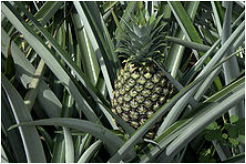
A pineapple, on its parent plant
|
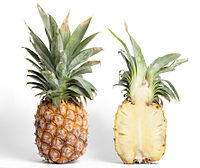
Pineapple and its cross section
|
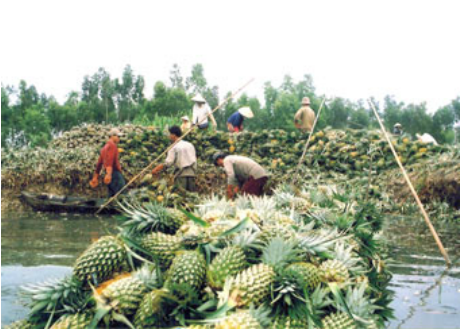
Harvesting Pineapples in Vietanam
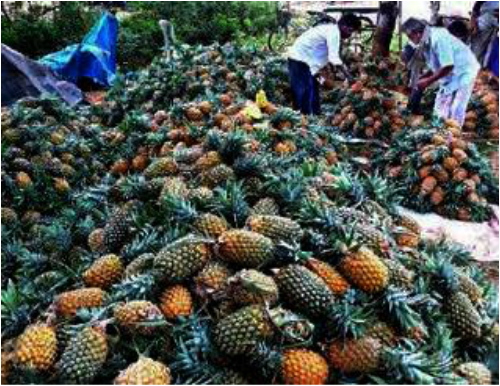
Pineapple fruits for sale in Tan Phuoc distrist, Tien Giang provine, Vietnam.
2.2- Origin and Distribution
+ Origin:
It is a cultigen not known in the wild presumably originated from the area between Southern Brazil and Paraguay, South America.
+ Distribution:
It is a pantropical plant widely grown for its edible fruits that has been cultivated in South America since the fifteenth century and now it is intensively cultivated in several tropical countries, such as Hawaii, India, Malaysia, Philippines, Vietnam and Thailand.
+ Origin:
It is a cultigen not known in the wild presumably originated from the area between Southern Brazil and Paraguay, South America.
+ Distribution:
It is a pantropical plant widely grown for its edible fruits that has been cultivated in South America since the fifteenth century and now it is intensively cultivated in several tropical countries, such as Hawaii, India, Malaysia, Philippines, Vietnam and Thailand.
2.3- Botany
The pineapple is a herbaceous perennial which grows to 1.0 to 1.5 meters (3.3 to 4.9 ft) tall, although sometimes it can be taller. In appearance, the plant itself has a short, stocky stem with tough, waxy leaves. When creating its fruit, it usually produces up to 200 flowers, although some large-fruited cultivars can exceed this. Once it flowers, the individual fruits of the flowers join together to create what is commonly referred to as a pineapple. After the first fruit is produced, side shoots (called 'suckers' by commercial growers) are produced in the leaf axils of the main stem. These may be removed for propagation, or left to produce additional fruits on the original plant.
Commercially, suckers that appear around the base are cultivated. It has 30 or more long, narrow, fleshy, trough-shaped leaves with sharp spines along the margins that are 30 to 100 centimeters (1.0 to 3.3 ft) long, surrounding a thick stem. In the first year of growth, the axis lengthens and thickens, bearing numerous leaves in close spirals. After 12 to 20 months, the stem grows into a spike-like inflorescence up to 15 cm (6 in) long with over 100 spirally arranged, trimerous flowers, each subtended by a bract. Flower colors vary, depending on variety, from lavender, through light purple to red.
The ovaries develop into berries which coalesce into a large, compact, multiple accessory fruit. The fruit of a pineapple is arranged in two interlocking helices, eight in one direction, thirteen in the other, each being a Fibonacci number.
Pineapple carries out CAM photosynthesis, fixing carbon dioxide at night and storing it as the acid malate and then releasing it during the day, aiding photosynthesis.
The pineapple is a herbaceous perennial which grows to 1.0 to 1.5 meters (3.3 to 4.9 ft) tall, although sometimes it can be taller. In appearance, the plant itself has a short, stocky stem with tough, waxy leaves. When creating its fruit, it usually produces up to 200 flowers, although some large-fruited cultivars can exceed this. Once it flowers, the individual fruits of the flowers join together to create what is commonly referred to as a pineapple. After the first fruit is produced, side shoots (called 'suckers' by commercial growers) are produced in the leaf axils of the main stem. These may be removed for propagation, or left to produce additional fruits on the original plant.
Commercially, suckers that appear around the base are cultivated. It has 30 or more long, narrow, fleshy, trough-shaped leaves with sharp spines along the margins that are 30 to 100 centimeters (1.0 to 3.3 ft) long, surrounding a thick stem. In the first year of growth, the axis lengthens and thickens, bearing numerous leaves in close spirals. After 12 to 20 months, the stem grows into a spike-like inflorescence up to 15 cm (6 in) long with over 100 spirally arranged, trimerous flowers, each subtended by a bract. Flower colors vary, depending on variety, from lavender, through light purple to red.
The ovaries develop into berries which coalesce into a large, compact, multiple accessory fruit. The fruit of a pineapple is arranged in two interlocking helices, eight in one direction, thirteen in the other, each being a Fibonacci number.
Pineapple carries out CAM photosynthesis, fixing carbon dioxide at night and storing it as the acid malate and then releasing it during the day, aiding photosynthesis.
2.4- Nutrition
Raw pineapple is an excellent source of manganese (76% daily value (DV) in a one US cup serving) and vitamin C (131% DV per cup serving). Mainly from its stem, pineapple contains a proteolytic enzyme, bromelain, which breaks down protein. If having sufficient bromelain content, raw pineapple juice may be used as a meat marinade and tenderizer. Pineapple enzymes can interfere with the preparation of some foods, such as jelly and other gelatin-based desserts, but would be destroyed during cooking and canning. The quantity of bromelain in the fruit is probably not significant, being mostly in the inedible stalk. Furthermore, an ingested enzyme like bromelain is unlikely to survive intact the proteolytic processes of digestion.
Nutritional value per 100 g (3.5 oz) of Pineapple, raw:
Raw pineapple is an excellent source of manganese (76% daily value (DV) in a one US cup serving) and vitamin C (131% DV per cup serving). Mainly from its stem, pineapple contains a proteolytic enzyme, bromelain, which breaks down protein. If having sufficient bromelain content, raw pineapple juice may be used as a meat marinade and tenderizer. Pineapple enzymes can interfere with the preparation of some foods, such as jelly and other gelatin-based desserts, but would be destroyed during cooking and canning. The quantity of bromelain in the fruit is probably not significant, being mostly in the inedible stalk. Furthermore, an ingested enzyme like bromelain is unlikely to survive intact the proteolytic processes of digestion.
Nutritional value per 100 g (3.5 oz) of Pineapple, raw:
|
Energy..............................................................
Carbohydrates Sugars Dietary fiber Fat................................................................... Protein Vitamins Thiamine (B1) Riboflavin (B2) Niacin (B3)....................................................... Pantothenic acid (B5) Vitamin B6 Folate (B9) Choline Vitamin C......................................................... Trace metals Calcium Iron Magnesium Manganese......................................................... Phosphorus Potassium Sodium Zinc.................................................................... |
209 kJ (50 kcal)
13.12 g 9.85 g 1.4 g 0.12 g 0.54 g : 0.079 mg (7%) 0.032 mg (3%) 0.5 mg (3%) 0.213 mg (4%) 0.112 mg (9%) 18 μg (5%) 5.5 mg (1%) 47.8 mg (58%) : 13 mg (1%) 0.29 mg (2%) 12 mg (3%) 0.927 mg (44%) 8 mg (1%) 109 mg (2%) 1 mg (0%) 0.12 mg (1%) |
Note!
+ Units: μg = micrograms • mg = milligrams * IU = International units
+ Percentages are roughly approximated usingUS recommendations for adults.
Source: USDA Nutrient Database - Link to USDA Database entry
+ Units: μg = micrograms • mg = milligrams * IU = International units
+ Percentages are roughly approximated usingUS recommendations for adults.
Source: USDA Nutrient Database - Link to USDA Database entry
2.5- The Uses of Pineapples
+ Culinary uses
The flesh and juice of the pineapple are used in cuisines around the world. In many tropical countries, pineapple is prepared, and sold on roadsides as a snack. It is sold whole, or in halves with a stick inserted. Whole, cored slices with a cherry in the middle are a common garnish on hams in the West. Chunks of pineapple are used in desserts such as fruit salad, as well as in some savory dishes, including pizza toppings and a grilled ring on a hamburger. Crushed pineapple is used in yogurt, jam, sweets, and ice cream.
+ Used as Processing food
Pineapple may be consumed fresh, canned, juiced, and are found in a wide array of food stuffs dessert, fruit salad, jam, yoghurt, ice cream, candy, and as a complement to meat dishes.
The juice of the pineapple is served as a beverage, and is also as a main ingredient in such cocktails as the piña colada.
+ Medicinal uses
- Pineapple: Rich in medicinal properties
Pineapple is a rich source of digestive enzymes. It gives instant feeling of freshness. It gives strength to the heart. It is a brain tonic. It destroys parasitic worms. It gives instant energy. It promotes excellence of complexion. In summer, it gives freshness and coolness to the body. Its juice helps in digestion of high protein foods. It also strengthens intestines. But these properties are present in the freshly prepared pineapple juice. Canned pineapple juice is harmful to health.
As compared to pineapple pulp, its juice is more beneficial. Juice extracted from small pineapple pieces by pressing them in a muslin cloth has remarkable nutritional values whereas the juice extracted by juicer machine is deficient in nutritive compounds and it is difficult to digest. It is better to use the cut fruits or juice immediately. It contains an enzyme namely bromelain, which is similar to pepsin in medicinal properties. Pineapple helps in excretion of toxic wastes deposited in the body and thereby strengthens the body.
- Precautions:
• Pineapple increases kapha so it is contraindicated in cases of chronic cold, cough, asthma, fever, joint pain and pregnancy.
• One should consume fresh, ripe and sweet pineapple juice only. It is better to avoid raw, sour or over-ripe fruit.
• It is contraindicated in cases of hyperacidity and persistent cold.
• Never take pineapple flavored ice-cream or milkshakes containing pineapple juice as there are extremely harmful to the health.
• One should consurne pineapple juice either during the meal, or half an hour after the meal.
• Do not eat pineapple when you are hungry or your physical constitution is of pitta type. It may cause abdominal colic.
• Young children should not be given pineapple. It causes disturbance to the functions of stomach and intestines.
• One should not take fruits and fruit juices after the sunset
Source: Pineapple-Rich-in-medicinal-properties.aspx
+ Other uses
- Ornamental uses:
Specimen plant; mass planting; container plant; tropical foliage and colourful flowers. Some ornamental varieties, including variegated cultivars are very valuable landscape plants that require very little care and create exotic tropical look.
- Industry uses:
In addition to consumption the pineapple's leaves are used as the source of a textile fibre, and is employed as a component of wall paper and furnishings, amongst other uses.
- Usage in culture:
In the Caribbean, Europe and North America, the pineapple became associated with the return of ships from extended voyages, and an emblem of welcome and hospitality that made its way into contemporary art.
In the television show Psych, the writers have included a pineapple in every episode as a running joke, and there's a website dedicated to compiling a list of every pineapple.
In the American cartoon Sponge Bob Square Pants, SpongeBob's home is a pineapple under the sea.
+ Culinary uses
The flesh and juice of the pineapple are used in cuisines around the world. In many tropical countries, pineapple is prepared, and sold on roadsides as a snack. It is sold whole, or in halves with a stick inserted. Whole, cored slices with a cherry in the middle are a common garnish on hams in the West. Chunks of pineapple are used in desserts such as fruit salad, as well as in some savory dishes, including pizza toppings and a grilled ring on a hamburger. Crushed pineapple is used in yogurt, jam, sweets, and ice cream.
+ Used as Processing food
Pineapple may be consumed fresh, canned, juiced, and are found in a wide array of food stuffs dessert, fruit salad, jam, yoghurt, ice cream, candy, and as a complement to meat dishes.
The juice of the pineapple is served as a beverage, and is also as a main ingredient in such cocktails as the piña colada.
+ Medicinal uses
- Pineapple: Rich in medicinal properties
Pineapple is a rich source of digestive enzymes. It gives instant feeling of freshness. It gives strength to the heart. It is a brain tonic. It destroys parasitic worms. It gives instant energy. It promotes excellence of complexion. In summer, it gives freshness and coolness to the body. Its juice helps in digestion of high protein foods. It also strengthens intestines. But these properties are present in the freshly prepared pineapple juice. Canned pineapple juice is harmful to health.
As compared to pineapple pulp, its juice is more beneficial. Juice extracted from small pineapple pieces by pressing them in a muslin cloth has remarkable nutritional values whereas the juice extracted by juicer machine is deficient in nutritive compounds and it is difficult to digest. It is better to use the cut fruits or juice immediately. It contains an enzyme namely bromelain, which is similar to pepsin in medicinal properties. Pineapple helps in excretion of toxic wastes deposited in the body and thereby strengthens the body.
- Precautions:
• Pineapple increases kapha so it is contraindicated in cases of chronic cold, cough, asthma, fever, joint pain and pregnancy.
• One should consume fresh, ripe and sweet pineapple juice only. It is better to avoid raw, sour or over-ripe fruit.
• It is contraindicated in cases of hyperacidity and persistent cold.
• Never take pineapple flavored ice-cream or milkshakes containing pineapple juice as there are extremely harmful to the health.
• One should consurne pineapple juice either during the meal, or half an hour after the meal.
• Do not eat pineapple when you are hungry or your physical constitution is of pitta type. It may cause abdominal colic.
• Young children should not be given pineapple. It causes disturbance to the functions of stomach and intestines.
• One should not take fruits and fruit juices after the sunset
Source: Pineapple-Rich-in-medicinal-properties.aspx
+ Other uses
- Ornamental uses:
Specimen plant; mass planting; container plant; tropical foliage and colourful flowers. Some ornamental varieties, including variegated cultivars are very valuable landscape plants that require very little care and create exotic tropical look.
- Industry uses:
In addition to consumption the pineapple's leaves are used as the source of a textile fibre, and is employed as a component of wall paper and furnishings, amongst other uses.
- Usage in culture:
In the Caribbean, Europe and North America, the pineapple became associated with the return of ships from extended voyages, and an emblem of welcome and hospitality that made its way into contemporary art.
In the television show Psych, the writers have included a pineapple in every episode as a running joke, and there's a website dedicated to compiling a list of every pineapple.
In the American cartoon Sponge Bob Square Pants, SpongeBob's home is a pineapple under the sea.
2.6- Health Benefits of Pineapples
+ The pineapple’s main health benefits
1- Reduces inflammation
The enzyme bromelain, which is extracted from pineapple, is used to treat a number of conditions, but is particularly effective in reducing inflammation from infection and injuries. Bromelain also decreases osteoarthritic pain, so is relevant to you if you suffer from arthritis, gout, joint pain and chronic inflammation. Bromelain is also used for reducing swelling (inflammation), especially of the nose and sinuses. Bromelain also contains chemicals that interfere with the growth of tumor cells and slow blood clotting.
Further reading: also read my article about these foods to reduce inflammation in your body.
2- Improves immune system
Pineapples are packed with Vitamin C. High concentration of vitamin C is known to boost immune system and acts as an antioxidant. It also provides a boost to your immune system by helping to shorten the duration of colds. Find more information on how to improve your immunity in my previous articles how to boost your immune system naturally and 10 Quick Life Hacks to Improve Your Immunity Almost Immediately.
Pineapples are also loaded with vitamins and minerals including vitamin A, manganese, copper, vitamin B1, vitamin B6, dietary fiber, folate calcium, phosphorus, and potassium. Pineapples are also known for their ability to build and maintain strong bones due to the content of the trace mineral manganese, which your body needs to build bones and connective tissues.
3- Improves digestion
The enzyme bromelain, also aids digestion by breaking down proteins. This is why pineapple juice is often used in marinades, as the bromelain helps to tenderize the meat. The added benefit of marinating meat in pineapple juice is that the protein will reduce the inevitable spike in blood sugar levels from the pineapple’s sugar content. Find here how to make this delicious digestive detox smoothie which one of it’s ingredients is pineapple. To learn more about the concept of detox and how to use detox to cleanse and energize your body, you can find useful information in my e-book the The Detox Guide. The whole process helps to increase stamina and energy and improves the digestive process.
4- Protection against macular degeneration
This disease is the most common cause of vision loss for older adults and is caused by damage to the retina. Including pineapple in your diet can lower the risk of this disease because pineapples contain beta-carotene, which is important for healthy eyes. We’ve all heard that carrots are great for keeping our eyes strong and healthy, but actually research has proven that fruits are better for keeping your eyesight as adults. Find here more information about how to prevent eyesight problems and improve vision naturally.
5- Aids in weight management
Pineapple is a nutrient-dense food, which means that it provides a lot of nutritional benefit for a small amount of calories (one cup of cubed pineapple contains about 80 calories). Nutrient-dense foods can help with weight management as they help you feel full without adding too many calories, and provide you with fiber and a number of essential vitamins and minerals.
+ Pineapple Side Effects
If you are taking a prescription blood thinner, be careful with bromelain, which works similarly. Generally, you should take bromelain for only eight to ten days, but it may be tolerated for longer periods. Avoid overdosing and possible stomach upset by noting the product strength.
Source: How-to-use-pineapple-as-a-medicine
http://www.healthyandnaturalworld.com/how-to-use-pineapple-as-a-medicine/
+ The pineapple’s main health benefits
1- Reduces inflammation
The enzyme bromelain, which is extracted from pineapple, is used to treat a number of conditions, but is particularly effective in reducing inflammation from infection and injuries. Bromelain also decreases osteoarthritic pain, so is relevant to you if you suffer from arthritis, gout, joint pain and chronic inflammation. Bromelain is also used for reducing swelling (inflammation), especially of the nose and sinuses. Bromelain also contains chemicals that interfere with the growth of tumor cells and slow blood clotting.
Further reading: also read my article about these foods to reduce inflammation in your body.
2- Improves immune system
Pineapples are packed with Vitamin C. High concentration of vitamin C is known to boost immune system and acts as an antioxidant. It also provides a boost to your immune system by helping to shorten the duration of colds. Find more information on how to improve your immunity in my previous articles how to boost your immune system naturally and 10 Quick Life Hacks to Improve Your Immunity Almost Immediately.
Pineapples are also loaded with vitamins and minerals including vitamin A, manganese, copper, vitamin B1, vitamin B6, dietary fiber, folate calcium, phosphorus, and potassium. Pineapples are also known for their ability to build and maintain strong bones due to the content of the trace mineral manganese, which your body needs to build bones and connective tissues.
3- Improves digestion
The enzyme bromelain, also aids digestion by breaking down proteins. This is why pineapple juice is often used in marinades, as the bromelain helps to tenderize the meat. The added benefit of marinating meat in pineapple juice is that the protein will reduce the inevitable spike in blood sugar levels from the pineapple’s sugar content. Find here how to make this delicious digestive detox smoothie which one of it’s ingredients is pineapple. To learn more about the concept of detox and how to use detox to cleanse and energize your body, you can find useful information in my e-book the The Detox Guide. The whole process helps to increase stamina and energy and improves the digestive process.
4- Protection against macular degeneration
This disease is the most common cause of vision loss for older adults and is caused by damage to the retina. Including pineapple in your diet can lower the risk of this disease because pineapples contain beta-carotene, which is important for healthy eyes. We’ve all heard that carrots are great for keeping our eyes strong and healthy, but actually research has proven that fruits are better for keeping your eyesight as adults. Find here more information about how to prevent eyesight problems and improve vision naturally.
5- Aids in weight management
Pineapple is a nutrient-dense food, which means that it provides a lot of nutritional benefit for a small amount of calories (one cup of cubed pineapple contains about 80 calories). Nutrient-dense foods can help with weight management as they help you feel full without adding too many calories, and provide you with fiber and a number of essential vitamins and minerals.
+ Pineapple Side Effects
If you are taking a prescription blood thinner, be careful with bromelain, which works similarly. Generally, you should take bromelain for only eight to ten days, but it may be tolerated for longer periods. Avoid overdosing and possible stomach upset by noting the product strength.
Source: How-to-use-pineapple-as-a-medicine
http://www.healthyandnaturalworld.com/how-to-use-pineapple-as-a-medicine/
3- Growing Pineapples
3.1- History
Pineapple (Ananas comosus) belongs to the Bromeliaceae family, from which one of its most important compounds, the enzyme bromelain, was named.
Columbus encountered the pineapple in 1493 on the leeward island of Guadeloupe. He called it piña de Indes, meaning "pine of the Indians," and brought it back with him to Europe, thus making the pineapple the first bromeliad to leave the New World.
The Spanish introduced it into the Philippines, Hawaii (introduced in the early 19th century, first commercial plantation 1886), Zimbabwe and Guam. The fruit is said to have been first introduced in Hawaii when a Spanish ship brought it there in the 1500s. The Portuguese took the fruit from Brazil and introduced it into India by 1550.
By the end of the 16th century, Portuguese and Spanish explorers introduced pineapples into many of their colonies in Asia, Africa and the South Pacific, where the pineapple is still being grown today. Because of its rarity and high price in those times, it was considered as a status item.
In the 18th century, pineapples began to be cultivated in Hawaii. Other countries that commercially grow pineapples include Thailand, the Philippines, China, Brazil and Mexico.
Pineapple (Ananas comosus) belongs to the Bromeliaceae family, from which one of its most important compounds, the enzyme bromelain, was named.
Columbus encountered the pineapple in 1493 on the leeward island of Guadeloupe. He called it piña de Indes, meaning "pine of the Indians," and brought it back with him to Europe, thus making the pineapple the first bromeliad to leave the New World.
The Spanish introduced it into the Philippines, Hawaii (introduced in the early 19th century, first commercial plantation 1886), Zimbabwe and Guam. The fruit is said to have been first introduced in Hawaii when a Spanish ship brought it there in the 1500s. The Portuguese took the fruit from Brazil and introduced it into India by 1550.
By the end of the 16th century, Portuguese and Spanish explorers introduced pineapples into many of their colonies in Asia, Africa and the South Pacific, where the pineapple is still being grown today. Because of its rarity and high price in those times, it was considered as a status item.
In the 18th century, pineapples began to be cultivated in Hawaii. Other countries that commercially grow pineapples include Thailand, the Philippines, China, Brazil and Mexico.
3.2- Varieties of Pineapple
+ Introduction:
The pineapple (Ananas comosus) is a tropical plant with edible multiple fruit consisting of coalesced berries, and the most economically significant plant in the Bromeliaceae family. Pineapples may be cultivated from a crown cutting of the fruit, possibly flowering in 20-24 months and fruiting in the following six months. Pineapple does not ripen significantly post-harvest.
Pineapples have a wide cylindrical shape, a scaly green, brown or yellow skin and a regal crown of spiny, blue-green leaves. The fibrous flesh of pineapple is yellow in color and has a vibrant tropical flavor that balances the tastes of sweet and tart. The area closer to the base of the fruit has more sugar content and therefore a sweeter taste and more tender texture.
There are many cultivars. The leaves of the commonly grown "smooth cayenne" are smooth and it is the most commonly grown worldwide. Many cultivars have become distributed from its origins in Paraguay and the southern part of Brazil, and later improved stocks were introduced into the Americas, the Azores, Africa, India, Malaysia and Australia.
+ Varieties include:
'Hilo': a compact 1-1.5 kg (2-3 lb) Hawaiian variant of smooth cayenne, the fruit is more cylindrical and produces many suckers, but no slips.
'Kona sugarloaf': 2.5-3 kg (5-6 lb), white flesh with no woodiness in the center, cylindrical in shape, it has a high sugar content but no acid, an unusually sweet fruit.
'Natal queen': 1-1.5 kg (2-3 lb), golden yellow flesh, crisp texture and delicate mild flavor, well-adapted to fresh consumption, keeps well after ripening, spiny leaves, grown in Australia, Malaysia, and South Africa.
'Pernambuco' ('eleuthera'): 1-2 kg (2-4 lb) with pale yellow to white flesh, sweet, melting and excellent for eating fresh, poorly adapted for shipping, spiny leaves, grown in Latin America
'Red Spanish': 1-2 kg (2-4 lb), pale yellow flesh with pleasant aroma, squarish in shape, well-adapted for shipping as fresh fruit to distant markets, spiny leaves, grown in Latin America
'Smooth cayenne': 2.5-3 kg (5-6 lb), pale yellow to yellow flesh, cylindrical in shape, high sugar and acid content, well-adapted to canning and processing, leaves without spines. It is an ancient cultivar developed by Amerind peoples. Until recently, this was the variety from Hawaii, and the most easily obtainable in US grocery stores, but has been replaced by 'MD-2'. It is one of the ancestors of cultivars '73-114' (also called 'MD-2') and '73-50' (also called 'MD-1' and 'CO-2').
Some Ananas species are grown as ornamentals for color, novel fruit size and other esthetic qualities.
+ Introduction:
The pineapple (Ananas comosus) is a tropical plant with edible multiple fruit consisting of coalesced berries, and the most economically significant plant in the Bromeliaceae family. Pineapples may be cultivated from a crown cutting of the fruit, possibly flowering in 20-24 months and fruiting in the following six months. Pineapple does not ripen significantly post-harvest.
Pineapples have a wide cylindrical shape, a scaly green, brown or yellow skin and a regal crown of spiny, blue-green leaves. The fibrous flesh of pineapple is yellow in color and has a vibrant tropical flavor that balances the tastes of sweet and tart. The area closer to the base of the fruit has more sugar content and therefore a sweeter taste and more tender texture.
There are many cultivars. The leaves of the commonly grown "smooth cayenne" are smooth and it is the most commonly grown worldwide. Many cultivars have become distributed from its origins in Paraguay and the southern part of Brazil, and later improved stocks were introduced into the Americas, the Azores, Africa, India, Malaysia and Australia.
+ Varieties include:
'Hilo': a compact 1-1.5 kg (2-3 lb) Hawaiian variant of smooth cayenne, the fruit is more cylindrical and produces many suckers, but no slips.
'Kona sugarloaf': 2.5-3 kg (5-6 lb), white flesh with no woodiness in the center, cylindrical in shape, it has a high sugar content but no acid, an unusually sweet fruit.
'Natal queen': 1-1.5 kg (2-3 lb), golden yellow flesh, crisp texture and delicate mild flavor, well-adapted to fresh consumption, keeps well after ripening, spiny leaves, grown in Australia, Malaysia, and South Africa.
'Pernambuco' ('eleuthera'): 1-2 kg (2-4 lb) with pale yellow to white flesh, sweet, melting and excellent for eating fresh, poorly adapted for shipping, spiny leaves, grown in Latin America
'Red Spanish': 1-2 kg (2-4 lb), pale yellow flesh with pleasant aroma, squarish in shape, well-adapted for shipping as fresh fruit to distant markets, spiny leaves, grown in Latin America
'Smooth cayenne': 2.5-3 kg (5-6 lb), pale yellow to yellow flesh, cylindrical in shape, high sugar and acid content, well-adapted to canning and processing, leaves without spines. It is an ancient cultivar developed by Amerind peoples. Until recently, this was the variety from Hawaii, and the most easily obtainable in US grocery stores, but has been replaced by 'MD-2'. It is one of the ancestors of cultivars '73-114' (also called 'MD-2') and '73-50' (also called 'MD-1' and 'CO-2').
Some Ananas species are grown as ornamentals for color, novel fruit size and other esthetic qualities.
3.3- Propagation
Pineapple are typically propagated from new vegetative growth from the original (mother) plant. There are four types of common planting material:
- The crown of the fruit;
- Slips and hapas, which arise from the stalk below the fruit;
- Suckers, which arise from the leaf axils of leaves;
- and Ratoons, which arise from underground portions of the stem.
The crown consists of the leaves and top 13-19 mm (1/2 to 3/4 inches) of the top of the fruit.
Slips originate from the fruit stalk below the fruit and have a characteristic curve to the base of the leaves. Hapas are similar to slips but develop well below the base of the fruit and do not have the characteristic curve at the base of the leaves. Slips and hapas should be left on the peduncle for several weeks after harvesting the fruit in order to develop a usable size for planting.
Suckers develop along the bases of the leaves and also should be left on the plant after fruit harvest to develop usable size for planting. The central stem may also be used to propagate new plants and is usually cut into several pieces. In all cases, the larger the crowns, slips, hapas, suckers, and stem pieces, the more rapid the growth and time to fruiting after planting.
To start new plants, detach the slips, hapas, or crown from the original plant and let them air dry in the shade for a day or two. Plant in clean soil media in the prepared area of the landscape or in containers.
Pineapple are typically propagated from new vegetative growth from the original (mother) plant. There are four types of common planting material:
- The crown of the fruit;
- Slips and hapas, which arise from the stalk below the fruit;
- Suckers, which arise from the leaf axils of leaves;
- and Ratoons, which arise from underground portions of the stem.
The crown consists of the leaves and top 13-19 mm (1/2 to 3/4 inches) of the top of the fruit.
Slips originate from the fruit stalk below the fruit and have a characteristic curve to the base of the leaves. Hapas are similar to slips but develop well below the base of the fruit and do not have the characteristic curve at the base of the leaves. Slips and hapas should be left on the peduncle for several weeks after harvesting the fruit in order to develop a usable size for planting.
Suckers develop along the bases of the leaves and also should be left on the plant after fruit harvest to develop usable size for planting. The central stem may also be used to propagate new plants and is usually cut into several pieces. In all cases, the larger the crowns, slips, hapas, suckers, and stem pieces, the more rapid the growth and time to fruiting after planting.
To start new plants, detach the slips, hapas, or crown from the original plant and let them air dry in the shade for a day or two. Plant in clean soil media in the prepared area of the landscape or in containers.
3.4- Ecology
+ Climate
Pineapples are native to South America, but have since been introduced into warm climates all over the world because of their sweet, desirable fruit.
Today, pineapples are grown in Hawaii, Puerto Rico, Malaysia, and Brazil, as well as China, Florida, Thailand, the Philippines, Vietnam, India, Nigeria, Costa Rica, Mexico, and most other tropical countries. Hawaii is currently the largest producer of commercially grown pineapples. Most pineapples grown are canned, but many are also sold fresh or as juice, and the fibers of the leaves are used in many countries as well.
+ Temperatures
Pineapple plants do not tolerate freezing temperatures below -2.0°C (28°F), and temperatures below 15.5°C (60°F) and above 32°C (90°F) may slow plant growth. Optimum temperatures for pineapple growth range between 20-30°C (68°F and 86°F). Chilling injury caused by low, near freezing temperatures or light frosts may result in the upper leaf surfaces developing a red/white flecked, scorched appearance and pulp rotting of the fruit. Some protection may be obtained by covering outdoor pineapple plants with an insulating material such as blankets or mulch. Plants grown in containers may be taken inside.
The time from planting to harvest depends upon the cultivar, cultural practices, and temperature; it ranges from 18 to 24 months.
+ Drought
Pineapple plants are tolerant of dry soil and weather conditions, however, plant growth and fruit production will be reduced. Symptoms of drought develop slowly but include wilting of the older leaves, leaf color change from dark to pale green, then yellow and red, and curling of the leaf margins.
+ Flooding
Pineapple plants are not very tolerant of excessively or continuously wet or flooded soil conditions. Generally, growth and production are reduced and susceptibility to root rot is increased, which may lead to plant death.
+ Wind
In general, pineapple plants are tolerant of windy conditions, although some reduction in plant growth and fruit stalk toppling may occur. Symptoms of wind stress include browning of the leaf tips and margins. Hurrican-force winds may cause toppling or uprooting.
+ Climate
Pineapples are native to South America, but have since been introduced into warm climates all over the world because of their sweet, desirable fruit.
Today, pineapples are grown in Hawaii, Puerto Rico, Malaysia, and Brazil, as well as China, Florida, Thailand, the Philippines, Vietnam, India, Nigeria, Costa Rica, Mexico, and most other tropical countries. Hawaii is currently the largest producer of commercially grown pineapples. Most pineapples grown are canned, but many are also sold fresh or as juice, and the fibers of the leaves are used in many countries as well.
+ Temperatures
Pineapple plants do not tolerate freezing temperatures below -2.0°C (28°F), and temperatures below 15.5°C (60°F) and above 32°C (90°F) may slow plant growth. Optimum temperatures for pineapple growth range between 20-30°C (68°F and 86°F). Chilling injury caused by low, near freezing temperatures or light frosts may result in the upper leaf surfaces developing a red/white flecked, scorched appearance and pulp rotting of the fruit. Some protection may be obtained by covering outdoor pineapple plants with an insulating material such as blankets or mulch. Plants grown in containers may be taken inside.
The time from planting to harvest depends upon the cultivar, cultural practices, and temperature; it ranges from 18 to 24 months.
+ Drought
Pineapple plants are tolerant of dry soil and weather conditions, however, plant growth and fruit production will be reduced. Symptoms of drought develop slowly but include wilting of the older leaves, leaf color change from dark to pale green, then yellow and red, and curling of the leaf margins.
+ Flooding
Pineapple plants are not very tolerant of excessively or continuously wet or flooded soil conditions. Generally, growth and production are reduced and susceptibility to root rot is increased, which may lead to plant death.
+ Wind
In general, pineapple plants are tolerant of windy conditions, although some reduction in plant growth and fruit stalk toppling may occur. Symptoms of wind stress include browning of the leaf tips and margins. Hurrican-force winds may cause toppling or uprooting.
3.5- Soils
Pineapple plants grow best in moderately fertile, sandy loam soils of neutral to mildly acid pH. Plants will grow satisfactorily in sandy and calcareous soils with attention to watering and fertilizer. Pineapple should be grown in well-drained soils and areas of the landscape that do not flood.
Pineapples are best suited to humid coastal lowlands in tropical and subtropical regions of northern and eastern Australia. But in a warm, sunny, sheltered and frost free position, they will tolerate cool nights for short periods.
+ Planting in Sandy Soil
Many areas in Florida have sandy soil. Remove a 0.9-1.8 m (3 to 6 foot) diameter ring or 0.6 - 1.8 m (2foot by 6 foot) rectangle of grass sod. To plant single plants, dig a hole 3 to 4 times the diameter and 2 times as deep as the container the pineapple plant came in. Making a large hole loosens the soil next to the new plant, making it easy for the roots to expand into the adjacent soil. For planting on a rectangular bed, excavate the soil to a depth two times the depth of the container the plant came in and form a bed of mounded soil.
It is not necessary to apply fertilizer, topsoil, or compost to the hole. In fact, placing topsoil or compost in the hole first and then planting on top of it is not desirable. If you wish to add topsoil or compost to the native soil, mix it with the excavated soil in no more than a 1:1 ratio.
Remove the plant from the container and place it in a hole so that the top of the soil media from in the container is level with or slightly above the surrounding soil level. Fill soil in around the plant roots and tamp slightly to remove air pockets. Immediately water the soil around the plant.
+ Planting in Rockland Soil
Many areas in Miami-Dade County have a very shallow soil, and several inches below the soil surface is a hard, calcareous bedrock. To dig a hole or make a bed, use a pick and digging bar to break up the rock, or contract with a company that has augering equipment or a backhoe. If you wish to add topsoil or well-decomposed compost to the native soil, mix it with the excavated soil in no more than a 50-50 ratio. Plant the plant as described for sandy soils.
+ Planting on a Mound
Many areas in Florida are within 2.1 m (7 feet) or so of the water table and experience occasional flooding after heavy rains. To improve plant survival, consider planting pineapple plants on a 0.6-0.9 m by 1.2-1.5 m (2 to 3 foot high by 4 to 5 foot) diameter mound or bed of native soil. After the mound is made, dig a hole two times the diameter and two times as deep as the container the plant came in. In areas where the bedrock nearly comes to the surface (rockland soil), follow the recommendations for the previous section. In areas with sandy soil, follow the recommendations from the section on planting in sandy soil.
+ Planting in a Container
Pineapple plants are well adapted to planting in a container. Choose a 11- to 26-liter (3- to 7 gallon) container with drainage holes. The larger the container, the greater the potential for a large plant and fruit; small containers restrict the size of the plant and resulting fruit size. Use a well-drained potting soil mix and fill the container to within 2.5 cm (an inch) or so of the top. Water the soil before planting the plant (water should be seen draining from the drainage holes). Plant the pineapple in the center of the container and water in the plant well. Place the container in full sun for best growth. When the plant flowers and fruits, tie the stalk to a stake to prevent it from falling over. See the section on care of pineapple plants for further information.
Pineapple plants grow best in moderately fertile, sandy loam soils of neutral to mildly acid pH. Plants will grow satisfactorily in sandy and calcareous soils with attention to watering and fertilizer. Pineapple should be grown in well-drained soils and areas of the landscape that do not flood.
Pineapples are best suited to humid coastal lowlands in tropical and subtropical regions of northern and eastern Australia. But in a warm, sunny, sheltered and frost free position, they will tolerate cool nights for short periods.
+ Planting in Sandy Soil
Many areas in Florida have sandy soil. Remove a 0.9-1.8 m (3 to 6 foot) diameter ring or 0.6 - 1.8 m (2foot by 6 foot) rectangle of grass sod. To plant single plants, dig a hole 3 to 4 times the diameter and 2 times as deep as the container the pineapple plant came in. Making a large hole loosens the soil next to the new plant, making it easy for the roots to expand into the adjacent soil. For planting on a rectangular bed, excavate the soil to a depth two times the depth of the container the plant came in and form a bed of mounded soil.
It is not necessary to apply fertilizer, topsoil, or compost to the hole. In fact, placing topsoil or compost in the hole first and then planting on top of it is not desirable. If you wish to add topsoil or compost to the native soil, mix it with the excavated soil in no more than a 1:1 ratio.
Remove the plant from the container and place it in a hole so that the top of the soil media from in the container is level with or slightly above the surrounding soil level. Fill soil in around the plant roots and tamp slightly to remove air pockets. Immediately water the soil around the plant.
+ Planting in Rockland Soil
Many areas in Miami-Dade County have a very shallow soil, and several inches below the soil surface is a hard, calcareous bedrock. To dig a hole or make a bed, use a pick and digging bar to break up the rock, or contract with a company that has augering equipment or a backhoe. If you wish to add topsoil or well-decomposed compost to the native soil, mix it with the excavated soil in no more than a 50-50 ratio. Plant the plant as described for sandy soils.
+ Planting on a Mound
Many areas in Florida are within 2.1 m (7 feet) or so of the water table and experience occasional flooding after heavy rains. To improve plant survival, consider planting pineapple plants on a 0.6-0.9 m by 1.2-1.5 m (2 to 3 foot high by 4 to 5 foot) diameter mound or bed of native soil. After the mound is made, dig a hole two times the diameter and two times as deep as the container the plant came in. In areas where the bedrock nearly comes to the surface (rockland soil), follow the recommendations for the previous section. In areas with sandy soil, follow the recommendations from the section on planting in sandy soil.
+ Planting in a Container
Pineapple plants are well adapted to planting in a container. Choose a 11- to 26-liter (3- to 7 gallon) container with drainage holes. The larger the container, the greater the potential for a large plant and fruit; small containers restrict the size of the plant and resulting fruit size. Use a well-drained potting soil mix and fill the container to within 2.5 cm (an inch) or so of the top. Water the soil before planting the plant (water should be seen draining from the drainage holes). Plant the pineapple in the center of the container and water in the plant well. Place the container in full sun for best growth. When the plant flowers and fruits, tie the stalk to a stake to prevent it from falling over. See the section on care of pineapple plants for further information.
3.6- Spacing and Pruning
In general, pineapple plants should be planted in full sun for best growth and fruit production. Select a part of the landscape away from other trees, buildings and structures, and power lines. Remember, pineapple plants need full sun for best growth and production. Select the warmest area of the landscape that does not flood (or remain wet) after typical summer rains.
Pineapple plants are an excellent choice for planting in home landscapes with little open space. In general, pineapple plants should be planted in full sun for best growth and fruit production. Select a part of the landscape at least 1.5 m (5 feet) away from other trees, buildings and structures where minimal shading occurs. The distance between individual pineapple plants ranges from 21-91 cm (12 to 36 inches). In general, wider spacing among plants allows for production of larger plants and fruit than close spacing among plants.
In cold areas, planting near structures will afford plants some cold protection during the winter, but it will slow plant growth. In general, plant growth, time to flowering, and fruit size and quality will be reduced if plants are grown in the shade.
Removing suckers, slips, and hapas during plant growth and fruit development will hasten the development of the fruit and increase fruit size. However, allowing a few suckers or slips or hapas to grow will supply new planting material. After the first fruit is harvested.
In general, pineapple plants should be planted in full sun for best growth and fruit production. Select a part of the landscape away from other trees, buildings and structures, and power lines. Remember, pineapple plants need full sun for best growth and production. Select the warmest area of the landscape that does not flood (or remain wet) after typical summer rains.
Pineapple plants are an excellent choice for planting in home landscapes with little open space. In general, pineapple plants should be planted in full sun for best growth and fruit production. Select a part of the landscape at least 1.5 m (5 feet) away from other trees, buildings and structures where minimal shading occurs. The distance between individual pineapple plants ranges from 21-91 cm (12 to 36 inches). In general, wider spacing among plants allows for production of larger plants and fruit than close spacing among plants.
In cold areas, planting near structures will afford plants some cold protection during the winter, but it will slow plant growth. In general, plant growth, time to flowering, and fruit size and quality will be reduced if plants are grown in the shade.
Removing suckers, slips, and hapas during plant growth and fruit development will hasten the development of the fruit and increase fruit size. However, allowing a few suckers or slips or hapas to grow will supply new planting material. After the first fruit is harvested.
3.7- Fertilizer
+ Dry Mixes and Iron Soil Drenches
Dry fertilizer mixtures containing 6 to 10% nitrogen (N), 6 to 10% available phosphoric acid (P), 6 to 10% potash (K), and 4 to 6% magnesium (Mg) give satisfactory results with pineapple plants. Young plants should be fertilized with 1 to 2 oz (30-29 g) or less of NPK every 8 weeks increasing the amount as the plant grows. Plants growing in high-pH soils may be periodically fertilized with chelated iron material drenched around the base of the plant or sprayed with a liquid iron source.
+ Liquid Mixes
Pineapple plants may also be fertilized foliarly with mild solutions of nutrient mixes that include NPK and Mg. Follow the directions on the label of the mixed material to avoid leaf burn. Iron may be a component of some foliar nutrient mixes, however; if the material does not contain iron, a 1% solution of ferrous (iron) sulfate may be applied foliarly. Apply foliar nutrients applications every 8 to 10 weeks.
+ Micronutrient Mixes
Foliar sprays containing micronutrients such as zinc and manganese (iron is also sometimes a component) should be applied 2 to 3 times a year during the warm season. Follow the directions of the micronutrient mix material to avoid leaf burn.
+ Compost and Topsoil
A small amount of compost and/or top soil may be incorporated into the soil before planting. This will aid in root development and improve the water- and nutrient-holding capacity of the soil.
Source: EDIS website at http://edis.ifas.ufl.edu => http://edis.ifas.ufl.edu/mg055
+ Dry Mixes and Iron Soil Drenches
Dry fertilizer mixtures containing 6 to 10% nitrogen (N), 6 to 10% available phosphoric acid (P), 6 to 10% potash (K), and 4 to 6% magnesium (Mg) give satisfactory results with pineapple plants. Young plants should be fertilized with 1 to 2 oz (30-29 g) or less of NPK every 8 weeks increasing the amount as the plant grows. Plants growing in high-pH soils may be periodically fertilized with chelated iron material drenched around the base of the plant or sprayed with a liquid iron source.
+ Liquid Mixes
Pineapple plants may also be fertilized foliarly with mild solutions of nutrient mixes that include NPK and Mg. Follow the directions on the label of the mixed material to avoid leaf burn. Iron may be a component of some foliar nutrient mixes, however; if the material does not contain iron, a 1% solution of ferrous (iron) sulfate may be applied foliarly. Apply foliar nutrients applications every 8 to 10 weeks.
+ Micronutrient Mixes
Foliar sprays containing micronutrients such as zinc and manganese (iron is also sometimes a component) should be applied 2 to 3 times a year during the warm season. Follow the directions of the micronutrient mix material to avoid leaf burn.
+ Compost and Topsoil
A small amount of compost and/or top soil may be incorporated into the soil before planting. This will aid in root development and improve the water- and nutrient-holding capacity of the soil.
Source: EDIS website at http://edis.ifas.ufl.edu => http://edis.ifas.ufl.edu/mg055
3.8- Care after growing
+ Mulch
Mulching pineapple plants in the home landscape helps retain soil moisture, reduces weed problems next to the plant, and improves the soil near the surface. Mulch with a 5- to15-cm (2- to 6-inch) layer of bark, wood chips, or similar mulch material. Keep mulch 20-30 cm (8 to 12 inches ) from the base of the plant.
Water-permeable ground cloth may also be used as a mulch to suppress weed growth among closely spaced pineapple plants. A thin layer of natural mulch may then be placed on top of this for aesthetic purposes.
+ Irrigation (Watering)
Pineapple plants should be watered during extended dry periods for best plant growth and fruit production. Excessively drained soil that holds little water should be watered once a week.
+ Forcing
Pineapple can be "forced" to flower in order to produce fruit sooner than it would under natural conditions. If the plant is large and vigorous, the fruit produced will be about as large as if it had flowered normally; otherwise, fruit size and quality will be reduced by forcing.
If you can find calcium carbide, perhaps in a hobby store, drop three or four small pellets into a cup of ice water. When the solution stops fizzing, pour it into the center of the rosette whorl of leaves.
Naphthaleneacetic acid (about 7 mg per cup of water) poured into the rosette will also induce flowering. B-hydroxyethyl hydrazine (BOH) (5 ml per gallon) also works, as do other products that generate either acetylene or ethylene gas. The forcing treatment should be reapplied one week later.
Because pieces of apple fruit generate ethylene gas and can be used to hasten ripening of bananas, it may be possible to induce flowering of pineapple by placing pieces of an apple on the rosette and adjacent leaf axils.
+ Control pests and deseases
See in 3.10- Pests and diseases
+ Mulch
Mulching pineapple plants in the home landscape helps retain soil moisture, reduces weed problems next to the plant, and improves the soil near the surface. Mulch with a 5- to15-cm (2- to 6-inch) layer of bark, wood chips, or similar mulch material. Keep mulch 20-30 cm (8 to 12 inches ) from the base of the plant.
Water-permeable ground cloth may also be used as a mulch to suppress weed growth among closely spaced pineapple plants. A thin layer of natural mulch may then be placed on top of this for aesthetic purposes.
+ Irrigation (Watering)
Pineapple plants should be watered during extended dry periods for best plant growth and fruit production. Excessively drained soil that holds little water should be watered once a week.
+ Forcing
Pineapple can be "forced" to flower in order to produce fruit sooner than it would under natural conditions. If the plant is large and vigorous, the fruit produced will be about as large as if it had flowered normally; otherwise, fruit size and quality will be reduced by forcing.
If you can find calcium carbide, perhaps in a hobby store, drop three or four small pellets into a cup of ice water. When the solution stops fizzing, pour it into the center of the rosette whorl of leaves.
Naphthaleneacetic acid (about 7 mg per cup of water) poured into the rosette will also induce flowering. B-hydroxyethyl hydrazine (BOH) (5 ml per gallon) also works, as do other products that generate either acetylene or ethylene gas. The forcing treatment should be reapplied one week later.
Because pieces of apple fruit generate ethylene gas and can be used to hasten ripening of bananas, it may be possible to induce flowering of pineapple by placing pieces of an apple on the rosette and adjacent leaf axils.
+ Control pests and deseases
See in 3.10- Pests and diseases
3.9- Harvest, Ripening, and Storage
+ Harvesting
For optimum fruit sweetness, pineapple fruit should be harvested when 1/3 to 2/3 or more of the peel (called a shell) color has turned from green to yellow. Alternatively, fruit may be picked at a late mature green stage (fully mature, full size but not turning yellow) and allowed to ripen at room temperature.
+ Ripening
Complete ripening may then be allowed at room temperature 26-28°C (78-82°F) before refrigeration. Generally, once it is ripe, fruit may be held in the refrigerator for up to a week before use. Immature (green fruit) should not be placed in the refrigerator because this may cause chilling injury and the fruit will not ripen properly.
+ Selecting and storing pineapples
1. Look for pineapples that are heavy for their size and have dark green leaves, and eat them within 2-3 days for best results.
2. Choose Pineapples that don’t have soft spots, wrinkled skin and bruises which may indicate that the pineapple is past its prime.
3. For the most antioxidants, choose fully ripened pineapple (pineapple stops ripening as soon as it is picked). A sweet scent is generally considered the most important aspect of choosing a ripe pineapple.
4. A whole pineapple can be left at room temperature for one or two days before serving. After two days, if you are still not ready to eat it, you should store it in the refrigerator where it will keep longer (a whole pineapple can last up to 2 weeks, and a cut pineapple will last for up to one week).
5. Once you cut the pineapple, you should store it in the refrigerator in an airtight container.
6. Although pineapple can be frozen for up to 6 months, this process greatly affects its flavor.
+ Harvesting
For optimum fruit sweetness, pineapple fruit should be harvested when 1/3 to 2/3 or more of the peel (called a shell) color has turned from green to yellow. Alternatively, fruit may be picked at a late mature green stage (fully mature, full size but not turning yellow) and allowed to ripen at room temperature.
+ Ripening
Complete ripening may then be allowed at room temperature 26-28°C (78-82°F) before refrigeration. Generally, once it is ripe, fruit may be held in the refrigerator for up to a week before use. Immature (green fruit) should not be placed in the refrigerator because this may cause chilling injury and the fruit will not ripen properly.
+ Selecting and storing pineapples
1. Look for pineapples that are heavy for their size and have dark green leaves, and eat them within 2-3 days for best results.
2. Choose Pineapples that don’t have soft spots, wrinkled skin and bruises which may indicate that the pineapple is past its prime.
3. For the most antioxidants, choose fully ripened pineapple (pineapple stops ripening as soon as it is picked). A sweet scent is generally considered the most important aspect of choosing a ripe pineapple.
4. A whole pineapple can be left at room temperature for one or two days before serving. After two days, if you are still not ready to eat it, you should store it in the refrigerator where it will keep longer (a whole pineapple can last up to 2 weeks, and a cut pineapple will last for up to one week).
5. Once you cut the pineapple, you should store it in the refrigerator in an airtight container.
6. Although pineapple can be frozen for up to 6 months, this process greatly affects its flavor.
3.10- Pests and diseases
+ Pests
- Animal pests
Raccoons, squirrels, and opposums will sometimes feed on maturing pineapple fruit. To help prevent this, cover the developing fruit with a paper bag or newspaper.
- Insect pests
Some pests that commonly affect pineapple plants are scales, thrips, mites, mealybugs, ants, and symphylids.
Pineapple plants may be attacked by various mealybugs, scales, and root-feeding grubs of several beetle species. Prior to planting, inspect the pineapple plant (especially the undersides of the lower leaves) for mealybugs and scales; if needed treat for control and then plant.
Mealybugs may attack the leaves and lateral, shallow roots, weakening the plant and decreasing fruit production. Ants commonly "farm" mealybugs and scales by protecting them from natural predators and moving them to new feeding sites. Controlling ants will decrease the likelihood of mealybug infestations.
Scales attack the leaves of pineapple plants, which weakens the plant. To prevent scale infestations, use clean soil media to start new plants and inspect plants frequently.
- Nematodes, parasitic
Several nematodes may cause significant injury to pineapple roots including root knot (Meloidogyne spp.) and reniform (Rotylenchulus reniformis) nematodes. Symptoms include plant decline, stunted development and reduced fruit production. Plant only vigorous plant material. If possible inspect the roots for signs of nematode feeding before planting, and discard planting material with signs of infestation. The best control is not to introduce nematode-infested soil or plant material into the pineapple planting area.
Lesion:
Pratylenchus brachyurus
Paratylenchus elachistus = Pratylenchus minutus
Reniform: Rotylenchulus reniformis
Root-knot: Meloidogyne javanica
Spiral: Helicotylenchus spp.
+ Diseases
Pineapple root rots may be caused by various Phytophthora and Pythium species which attack and destroy the root system. Symptoms include a reduction in plant growth, development of reddish colored leaves, browning of leaf margins, and plant decline and death. Primary control is to use disease-free planting material and avoid long periods of excessive soil moisture. These rot-causing organisms may spread through the main stem and infect developing fruit as well.
See also: List of pineapple diseases
+ Pests
- Animal pests
Raccoons, squirrels, and opposums will sometimes feed on maturing pineapple fruit. To help prevent this, cover the developing fruit with a paper bag or newspaper.
- Insect pests
Some pests that commonly affect pineapple plants are scales, thrips, mites, mealybugs, ants, and symphylids.
Pineapple plants may be attacked by various mealybugs, scales, and root-feeding grubs of several beetle species. Prior to planting, inspect the pineapple plant (especially the undersides of the lower leaves) for mealybugs and scales; if needed treat for control and then plant.
Mealybugs may attack the leaves and lateral, shallow roots, weakening the plant and decreasing fruit production. Ants commonly "farm" mealybugs and scales by protecting them from natural predators and moving them to new feeding sites. Controlling ants will decrease the likelihood of mealybug infestations.
Scales attack the leaves of pineapple plants, which weakens the plant. To prevent scale infestations, use clean soil media to start new plants and inspect plants frequently.
- Nematodes, parasitic
Several nematodes may cause significant injury to pineapple roots including root knot (Meloidogyne spp.) and reniform (Rotylenchulus reniformis) nematodes. Symptoms include plant decline, stunted development and reduced fruit production. Plant only vigorous plant material. If possible inspect the roots for signs of nematode feeding before planting, and discard planting material with signs of infestation. The best control is not to introduce nematode-infested soil or plant material into the pineapple planting area.
Lesion:
Pratylenchus brachyurus
Paratylenchus elachistus = Pratylenchus minutus
Reniform: Rotylenchulus reniformis
Root-knot: Meloidogyne javanica
Spiral: Helicotylenchus spp.
+ Diseases
Pineapple root rots may be caused by various Phytophthora and Pythium species which attack and destroy the root system. Symptoms include a reduction in plant growth, development of reddish colored leaves, browning of leaf margins, and plant decline and death. Primary control is to use disease-free planting material and avoid long periods of excessive soil moisture. These rot-causing organisms may spread through the main stem and infect developing fruit as well.
See also: List of pineapple diseases
4- The World Production of Pananas
Depending on FAO Statistics Division 2015 there were 87 countries growing pineapples in the year 2012.
Top 20 pineapple producers: Area (Ha), Yield (Kg/ha) and Production (tonnes) on the World (in the year 2012) included:
Top 20 pineapple producers: Area (Ha), Yield (Kg/ha) and Production (tonnes) on the World (in the year 2012) included:
|
Countries
1- Thailand 2- Costa Rica 3- Brazil 4- Philippines 5- Indonesia 6- India 7- Nigeria 8- China 9- Mexico 10- Colombia 11- Viet Nam 12- Kenya 13- Dominican Republic 14- Venezuela 15- Peru 16- Benin 17- Malaysia 18- Angola 19- Guatemala 20- Congo World (Total) Africa (Total) - Eastern Africa - Middle Africa - Northern Africa - Southern Africa - Western Africa Americas (Total) - Northern America - Central America - Caribbean - South America Asia (Total) - Eastern Asia - Southern Asia - South-Eastern Asia - Western Asia Europe (Total) - Southern Europe Oceania (Total) - Australia & New Zealand - Melanesia - Polynesia |
Area harvested (Ha)
105,000 42,000 60,653 58,442 14,300 90,500 180,000 61,000 17,708 13,916 40,000 13,899 11,990 19,000 16,000 6,549 15,611 36,030 8,650 8,250 995,888 347,191 56,376 53,960 1,800 8,500 226,555 232,098 6,000 78,852 20,487 126,759 411,717 61,380 110,827 239,495 15 260 260 4,622 2,700 1,510 412 |
Yield (Kg/Ha)
25,238.1 59,160.2 40,858.3 41,025.8 124,537.7 16,088.4 7,888.9 22,823.1 42,917.1 39,604.3 13,500.0 33,523.1 37,317.1 22,368.4 25,937.5 57,357.8 21,420.8 7,796.4 27,745.7 24,848.5 23,430.2 10,520.9 13,806.0 12,515.9 4,166.7 15,444.1 9,094.0 37,380.7 30,083.3 47,911.1 29,950.4 32,376.5 26,419.5 22,804.8 15,317.8 32,484.3 9,733.3 12,500.0 12,500.0 26,944.4 33,333.3 16,755.0 22,419.9 |
Production (tonnes)
2,650,000 2,484,729 2,478,178 2,397,628 1,780,889 1,456,000 1,420,000 1,392,211 759,976 551,133 540,000 465,938 447,432 425,000 415,000 375,636 334,400 280,906 240,000 205,000 23,333,886 3,652,746 778,329 675,356 7,500 131,275 2,060,286 8,676,001 180,500 3,777,885 613,605 4,104,011 10,877,352 1,399,761 1,697,628 7,779,817 146 3,250 3,250 124,537 90,000 25,300 9,237 |
Source: FAO Statistics Division 2015 | 02 June 2015
http://faostat.fao.org/site/567/DesktopDefault.aspx?PageID=567#ancor
http://faostat.fao.org/site/567/DesktopDefault.aspx?PageID=567#ancor
Edited by Ho Dinh Hai
Long An - Vietnam
References
1- http://en.wikipedia.org/wiki/Poales
2- http://en.wikipedia.org/wiki/Bromeliaceae
3- http://en.wikipedia.org/wiki/Bromelioideae
4- http://en.wikipedia.org/wiki/Ananas
5- http://en.wikipedia.org/wiki/Pineapple
6- http://edis.ifas.ufl.edu/mg055
7- http://aggie-horticulture.tamu.edu/citrus/pineapple.htm
8- http://www.tropicalpermaculture.com/growing-pineapples.html
9- http://cvsingh.hubpages.com/hub/Pineapple-Medicinal-Uses-and-Health-Benefits
10- http://www.healthyandnaturalworld.com/how-to-use-pineapple-as-a-medicine
11- http://www.llifle.com/Encyclopedia/BROMELIADS/.../Ananas_comosus
12- http://en.wikipedia.org/wiki/List_of_pineapple_diseases
-
Long An - Vietnam
References
1- http://en.wikipedia.org/wiki/Poales
2- http://en.wikipedia.org/wiki/Bromeliaceae
3- http://en.wikipedia.org/wiki/Bromelioideae
4- http://en.wikipedia.org/wiki/Ananas
5- http://en.wikipedia.org/wiki/Pineapple
6- http://edis.ifas.ufl.edu/mg055
7- http://aggie-horticulture.tamu.edu/citrus/pineapple.htm
8- http://www.tropicalpermaculture.com/growing-pineapples.html
9- http://cvsingh.hubpages.com/hub/Pineapple-Medicinal-Uses-and-Health-Benefits
10- http://www.healthyandnaturalworld.com/how-to-use-pineapple-as-a-medicine
11- http://www.llifle.com/Encyclopedia/BROMELIADS/.../Ananas_comosus
12- http://en.wikipedia.org/wiki/List_of_pineapple_diseases
-
See Video about: How Its Made Pineapples Discovery Channel
See Video about: Pineapple juice extraction
